I get asked this a lot, usually by students who are frustrated that food policy moves so slowly. The science on smoking was so overwhelming that it eventually reshaped laws, taxes, and norms around the world. Has nutrition science ever had a moment like that? It has, and the clearest example is industrial trans fat, the partially hydrogenated oils that once filled our margarines, doughnuts, crackers, and fryers.
The story starts with a 1990 controlled feeding trial by Mensink and Katan in the New England Journal of Medicine, which showed trans fats raise LDL ("bad") cholesterol and lower HDL ("good") cholesterol at the same time. Cohort data from the Nurses' Health Study followed in 1993. Thereafter, Denmark was the first to cap industrial trans fat in 2003, and New York City followed by restricting it in restaurants from 2007. Then, the FDA stripped partially hydrogenated oils of their "generally recognized as safe" status in 2015 in the U.S., and WHO launched its REPLACE package in 2018. But did any of it actually prevent heart attacks? That is the question this paper by Brandt et al (2017) set out to answer.
What the paper found
Between 2007 and 2011, 11 New York counties restricted trans fat in restaurants, bakeries, cafeterias, and other eateries, while 25 similar urban counties did not. That gave Eric Brandt and colleagues a natural experiment. They compared hospital admissions for heart attack and stroke in the two groups from 2002 to 2013. Three or more years after the restrictions began, admissions in the restricted counties had fallen an extra 6.2% beyond the background decline, and 7.8% for heart attacks alone.
That is a big effect for a policy most diners never noticed. And it doesn't stand alone. CDC researchers found that blood levels of trans fat in US white adults fell 58% between 2000 and 2009, as labeling and reformulation took hold. A synthetic-control study of Denmark estimated about 14 fewer cardiovascular deaths per 100,000 people per year in the three years after its 2004 limit. None of these are randomized trials, but three different designs point the same way. That evidence fed straight into the FDA's national phase-out, which took full effect in 2018. Today, best-practice trans fat policies cover around half the world's population, up from 6% in 2018.
The twist: what replaced it?
Trans fat didn't vanish into thin air. Something had to take its place, and palm oil was a big part of the answer. Because it is about half saturated fat, palm oil is semi-solid at room temperature, so it can mimic the texture and shelf life of hydrogenated oils, and it was cheap. The edible-oil industry's trade group told the FDA it expected palm oil and its fractions to be the first replacement of choice. US imports took off just as trans fat labeling became mandatory.
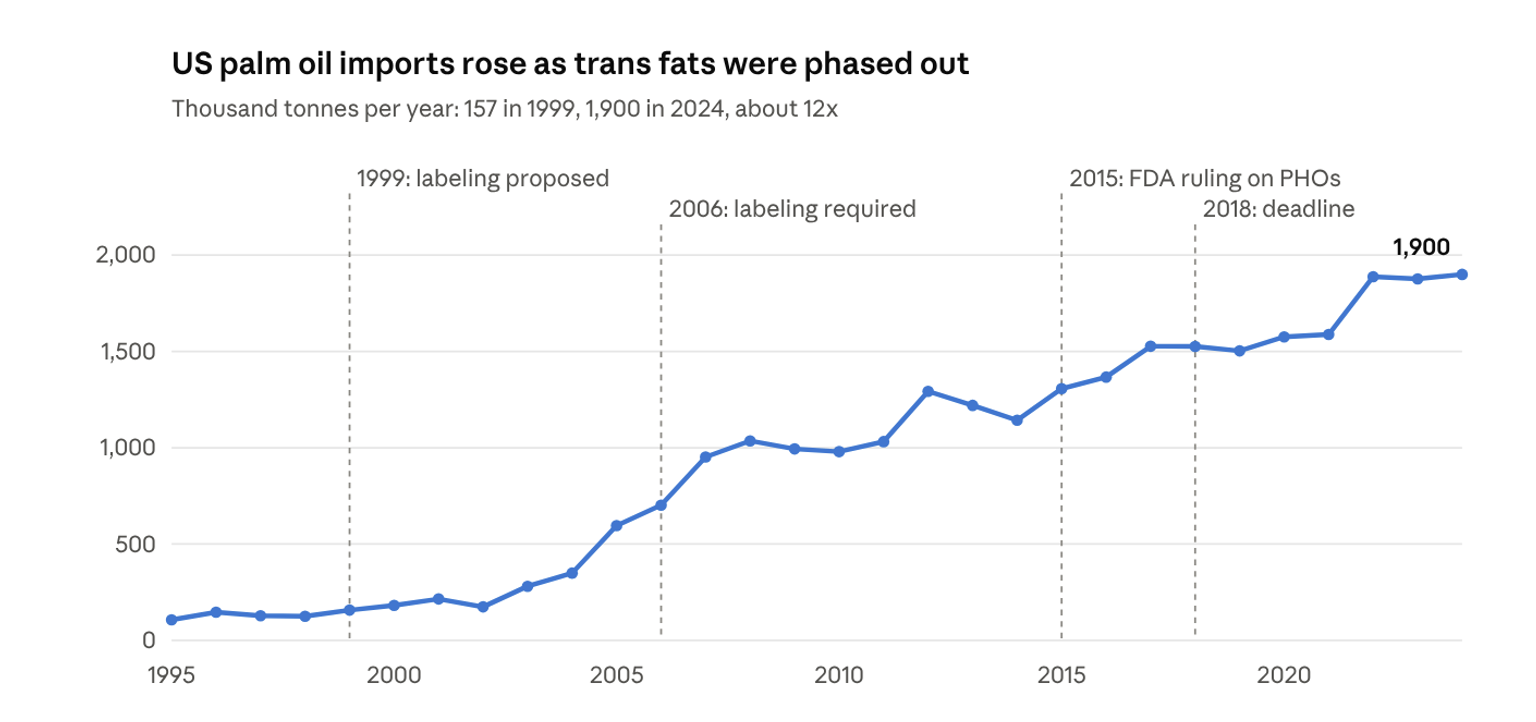
USDA FAS Production, Supply and Distribution data via IndexMundi · US palm oil imports, market years 1995–2024
Was that a bad trade? For heart health, mostly not. When Mozaffarian and colleagues looked at 83 reformulated foods, combined saturated plus trans fat fell in 90% of supermarket products and 96% of restaurant items. Gram for gram, trans fat is worse than saturated fat, so even the swaps that added saturated fat were a step up. But palm oil is no free pass: a meta-analysis of clinical trials found it raises LDL cholesterol by 0.24 mmol/L compared with oils low in saturated fat. High-oleic canola, soybean and sunflower oils were the healthier swap.
The higher cost is not related to non-communicable diseases. In Southeast Asia, 45% of sampled oil palm plantations sit on land that was forest in 1989, and more than 80% of the world's palm oil comes from Indonesia and Malaysia. The FDA wrote a health rule, but that rule didn't say where the replacement fat should come from. US demand is a small slice of the global palm market, so I wouldn't pin tropical deforestation on the trans fat ban. But it is a textbook food systems lesson: fix one problem in a silo, and the cost can move somewhere you aren't looking.
Why trans fat was special, and sugar isn't
So why did trans fat fall in a decade when sugar and ultra-processed foods are still fighting it out? Look at what the success stories have in common. Folic acid fortification (neural tube defects down 35% in the US), iodized salt, and vitamin A supplementation all check the same boxes: a single identifiable agent, strong causal evidence, a cheap fix or ready substitute, nothing asked of the person eating, and an industry that could absorb the change. Trans fat checked every one.
Diets don't work that way. Sugary drinks, salt, and ultra-processed foods are part of a larger dietary pattern, not ingredients, and the evidence is mostly observational. No drop-in replacement exists for a whole category of food, and these products sit at the heart of industry business models. Even tobacco only passed two of those five tests, which is why it took half a century, plus taxes, lawsuits, ad bans, and a cultural shift, to win. That is the real lesson for those of us working on diets today. Don't wait for tobacco-grade proof that may never come. Use the tobacco toolkit on strong-enough evidence. And when you do ban something, plan the replacement and watch where its footprint lands.
If you want to read more…
Brandt EJ et al. Hospital admissions for myocardial infarction and stroke before and after the trans-fatty acid restrictions in New York. JAMA Cardiology 2017;2:627–34. doi
Vesper HW et al. Levels of plasma trans-fatty acids in non-Hispanic white adults in the United States in 2000 and 2009. JAMA 2012;307:562–3. PMC
Restrepo BJ, Rieger M. Denmark's policy on artificial trans fat and cardiovascular disease. Am J Prev Med 2016;50:69–76. repository
Mozaffarian D, Jacobson MF, Greenstein JS. Food reformulations to reduce trans fatty acids. NEJM 2010;362:2037–9.
Sun Y et al. Palm oil consumption increases LDL cholesterol compared with vegetable oils low in saturated fat in a meta-analysis of clinical trials. J Nutr 2015;145:1549–58. article
Vijay V et al. The impacts of oil palm on recent deforestation and biodiversity loss. PLOS ONE 2016;11:e0159668. PMC
Williams J et al. Updated estimates of neural tube defects prevented by mandatory folic acid fortification, United States, 1995–2011. MMWR 2015;64:1–5. CDC
WHO. WHO recognizes four countries with life-saving trans fat elimination policies, 19 May 2025. WHO
US palm oil imports: USDA FAS PSD data via IndexMundi